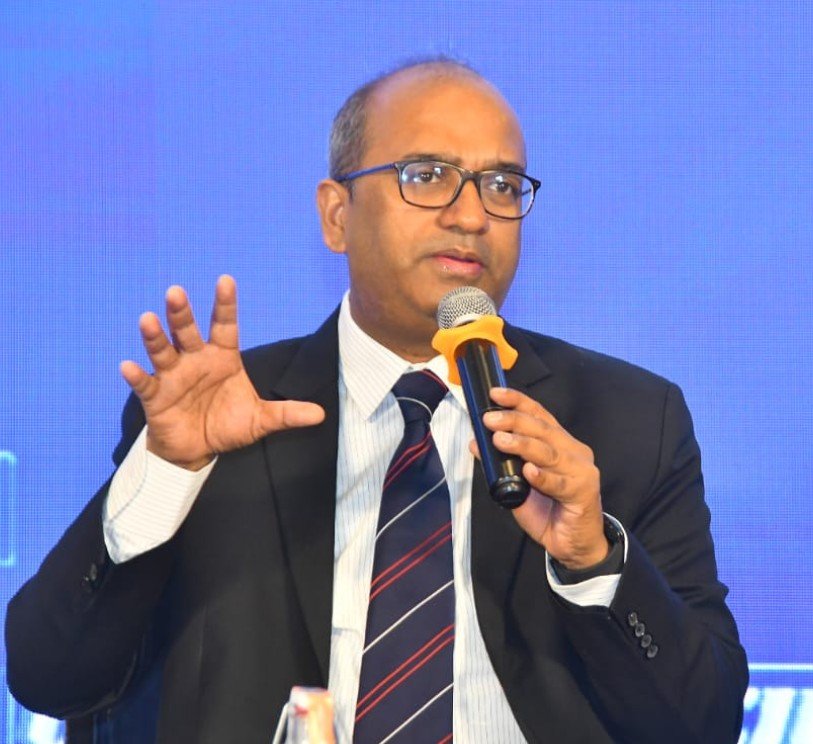

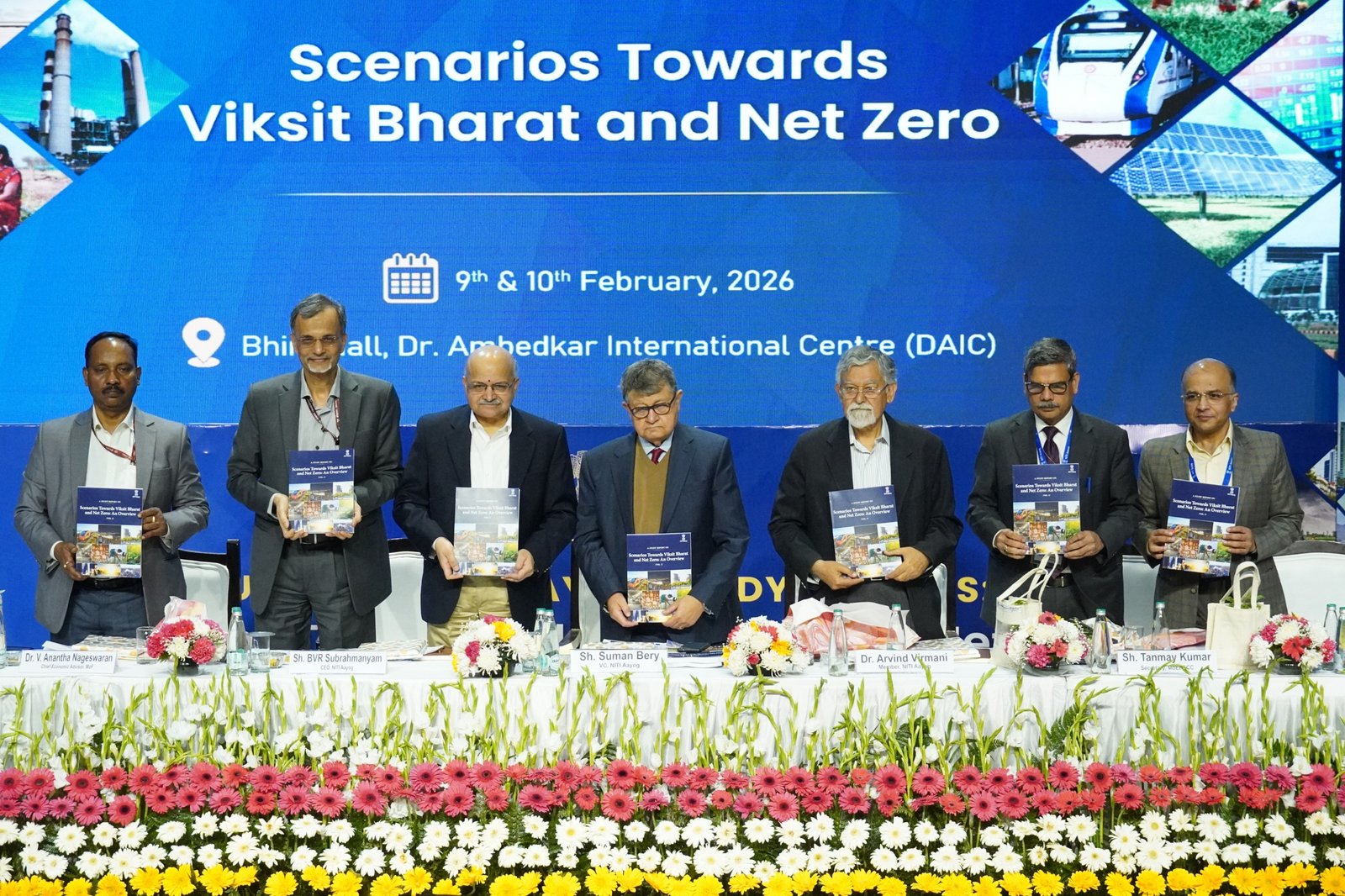
New Delhi, Feb 9 (LatestNewsX) NITI Aayog released three of the eleven study reports which it has compiled on scenarios towards Viksit Bharat and Net Zero on Monday at an event held at the Ambedkar International Centre in the national capital.
The remaining eight reports will be released on Tuesday.
The eleven reports detail the findings of India’s first government-led, multi-sectoral, integrated study to assess development scenarios that deliver on the Prime Minister’s vision of Viksit Bharat 2047 while simultaneously reducing net green-house gas (GHG) emissions to zero by 2070, according to an official statement.
NITI Aayog’s study entails a scenario-based analytic modelling exercise that integrates economic growth, India’s development priorities, and climate commitments.
The study has been informed by ten inter-ministerial working groups that examined long-term transition scenarios across key domains like macroeconomic aspects of the transition; sectoral low-carbon transition in power, transport, industry, buildings, and agriculture; financing for climate action; critical minerals; R&D and manufacturing; and the social implications of the transition. NITI Aayog undertook this comprehensive assessment to inform long-term policy planning.


The reports released at Monday’s event include the study on Scenarios towards Viksit Bharat and Net Zero: An Overview (Vol. 1). The synthesis report summarises the key findings emerging from the development scenarios assessed by NITI Aayog. The scenarios consider historical trends, current policies, and additional policy measures to accelerate demand electrification, enhance circularity, improve energy efficiency, promote the rapid development of low-carbon technologies and fuels, and encourage behavioural shifts.
The second report, titled Scenarios towards Viksit Bharat and Net Zero: Macroeconomic Implications (Vol. 2), details the macroeconomic implications of assessed development scenarios on GDP growth, investment, trade, jobs, and public finance, highlighting both trade-offs and synergies in India’s development pathway. The macroeconomic risk that climate change poses to agriculture, infrastructure, and health, compounded by rising carbon-related trade barriers, is also discussed.
The third report on Scenarios towards Viksit Bharat and Net Zero: Financing Needs (Vol. 9) examines India’s investment requirements in the key sectors of power, transport, and industry. The study concludes that an unprecedented capital mobilisation of $22.7 trillion by 2070 is required under the Net Zero scenario, including a projected financing gap of $6.5 trillion, and identifies the need for domestic financial reforms and stronger global capital integration.
Addressing the event, Suman Bery, Vice Chairperson, NITI Aayog, said, “As one of the world’s largest economies by 2070, India must be concerned for the welfare of its own citizens, and for the world that they will inhabit in the coming decades. Accordingly, the goal of Net Zero by 2070 provides guidance to Indian actors about a world beyond Viksit Bharat 2047. India’s own pathways will be influential for those to follow, particularly from the global south. I commend the NITI team for the detailed analysis of technologically feasible paths towards realising the Prime Minister’s vision and promise and, crucially, assessing the resource requirements: financial, technological and diplomatic that will be needed in this journey.”
In his address, B.V.R Subrahmanyam, CEO, NITI Aayog, said, “The Net Zero strategy is simple – first, electrify energy use. Two, green and clean electricity. Three, control demand through Mission LiFE. Four, focus on circularity and efficiency. Last, cheaper external finance is needed. Clearly stated, India’s coal consumption will go up till 2047 even as energy intensity decreases and efficiency goes up, while meeting Net Zero goals. India can leapfrog to be a global leader in clean technologies. 85 per cent of India by 2047 is yet to be built and can be built to be climate-friendly.”
Tanmay Kumar, Secretary, Ministry of Environment, Forest and Climate Change, said, “India will abide by Common and Differentiated responsibility and can meet Net Zero goals”.
V. Anantha Nageswaran, Chief Economic Advisor to the Government of India, Ministry of Finance, said, “NITI Aayog has undertaken a comprehensive and rigorous exercise that will serve as a benchmark – a starting point for future discussions on Viksit Bharat and Net Zero. The reports are a great resource for policymakers and researchers on charting India’s course to these twin objectives.”
sps/uk
Stay informed on all the latest news, real-time breaking news updates, and follow all the important headlines in world News on Latest NewsX. Follow us on social media Facebook, Twitter(X), Gettr and subscribe our Youtube Channel.