

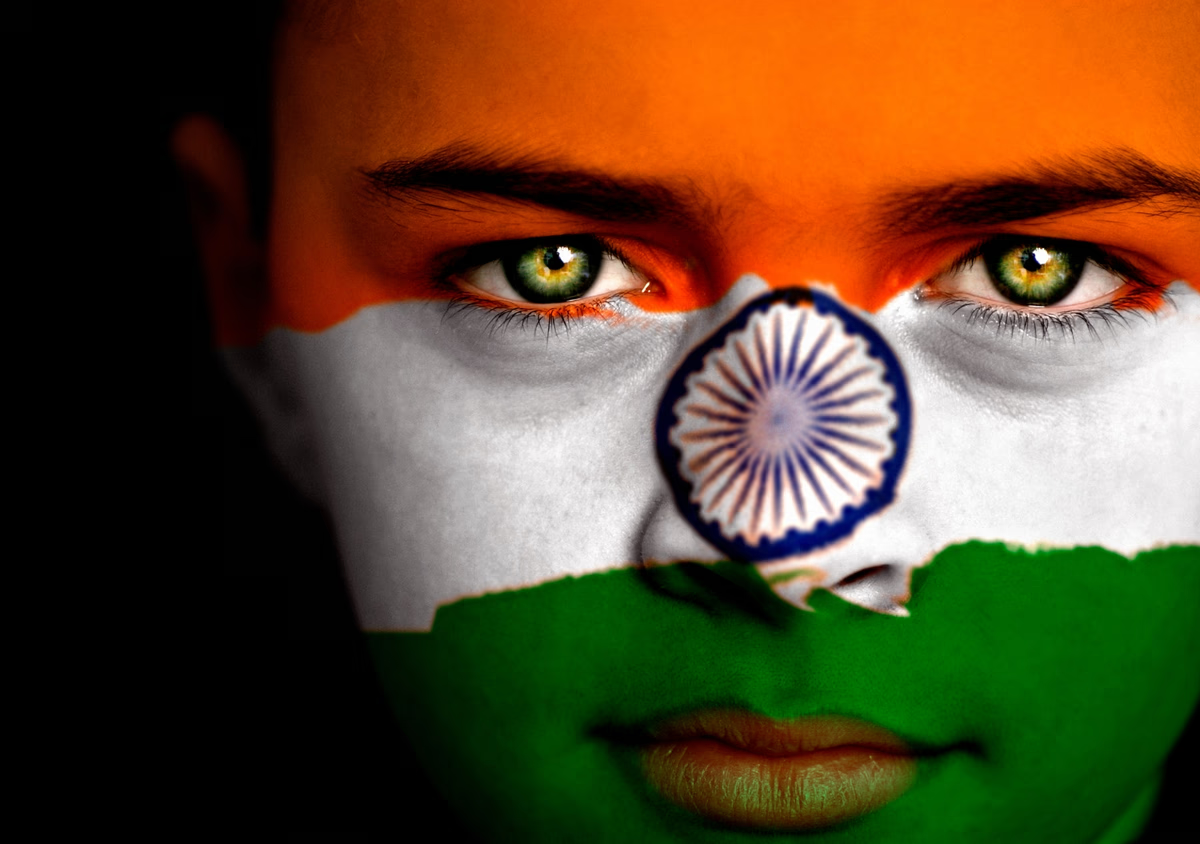
What should it mean to be an Indian?
The term ‘Indian’ can carry diverse attributes across multiple perspectives. Yet the definition that has gained the most traction in our social system is one that associates Indianness with undiluted pride in India’s democratic ethos and in the glory and framework of its Constitution. Undoubtedly, such pride should be seen as the defining marker of a true Indian.
With India’s deep-rooted cultural munificence being evoked and brought to the surface once again, and viewed through a conservative lens, one may also argue that a person with a comprehensive civilizational understanding of inclusion, both in principle and in practice, is a true Indian. Between the two, the latter, in my view, holds deeper meaning.
Being harmonious while remaining diverse is the finest epithet with which we can define the civilizational entity called India. This vast landscape, shaped by centuries of relentless struggle to recapitulate and reclaim its lost essence, has now reached a stumbling point, one where the weight of its democratic policy is heavily questioning its attempts at cultural retrieval.
There is little reason to fundamentally contradict India’s constitutional institutions and democratic principles, which ultimately shape its egalitarian character. However, the process of carving a civilizational state into one deeply embedded in constitutional principles came at a great cost. Independent India clearly witnessed a popular struggle in which hundreds of fragments of a cultural nation were diplomatically at times even forcefully gathered and brought together under the identity of political unanimity.
The history of India is the history of inclusion. And to mend and amend its historical distortions should be seen as a course correction. Swami Vivekananda made this clear while speaking in the West. The unique element that separates India from the rest of the world, he proclaimed, is its cultural affirmation. This, he argued, is the result of India’s vast civilizational memory, which would not only strengthen the nation spiritually but also enrich the world at large. India, he said, is defined by its historical continuity, its relentless flow that nurtures diverse forms of social organization and polytheistic ethnicities.

Vivekananda warned India to be cautious with this element of cultural stewardship, insisting that it must be preserved in all possible forms. But he firmly reminded this spiritual landscape not to alienate those diverse thoughts and philosophies that had sought asylum on its soil.
Obviously, India’s civilization has never been monolithic. It accommodated all those persecuted religions and sects on its shores that came seeking asylum. It rejected exclusivist religious fanaticism while proclaiming that all paths lead to the same truth.
Today, there is a profoundly well-crafted sentimental outrage at the academic and political level that distinctively demands the nullification of India being treated as a civilization, an assertion, they argue, is deeply threatening its democratic ambience. Everything, including this anger, agitation, and disquiet within intellectual circles and liberal academia, became loud and pronounced after the political shift India witnessed in 2014, which was largely accused of being an outcome of the politicization of India’s civilizational credentials. Majoritarian- they called it.
The shift maintained its consistency, crossing a decade and entering its third term of governance and the disquiet, however, continues within the liberal intelligentsia, who describe it as alarmingly dangerous.
The same seasoned intellectuals sought to have their liberal narratives framed against our cultural self-discovery, heard louder and clearer when India, under its robust judiciary, settled a centuries-old dispute and reclaimed one of its holiest centers of worship in Ayodhya. The jubilance and celebration in the aftermath were termed a crude civilizational self-assertion, purposefully designed for political gain. Outcries for the revival and reclamation of more cultural symbols by a section of society often referred to as the majority, were seen as attempts to distort India’s secular alignment. This, once again, has been described as an effort to evade reality, relying on emotionally gratifying narratives rather than hard facts.
Those who propagate this narrative rarely acknowledge the reality of India’s glorious past. It was not merely the post-colonial democratic framework that made India an aspirational candidate for its Vishwaguru stature once again; rather, it was its ancestry, deeply rooted in a cultural paradigm that this great land had preserved for eons but was later forced to discard or deliberately bury under the ruthless impact of colonial impulses.
As a democracy, India’s comprehensive growth will gain sustainable strength only if it does not forget its civilizational past. That said, an increasingly prominent attempt is being made to portray our reclamation of its distorted past as a form of cultural predation against minorities especially Muslims by a majoritarian establishment.
Shashi Tharoor has recently observed (Indian Express, January 29) that while majoritarian, the political shift that India has been passing through for a decade has evidently been on an outright civilizational self-assertion. He suspects that, in effect, attempts at such reclamation have never been inclusive enough. A divide, he calls it, has emerged so intensely damaging that its social structure is visibly divided into a Hindu–Muslim binary. Even though he hesitates to register his complete disregard for this self-assertion, his complaint is about its failure to use it as a tool for building a more inclusive and acceptable society wherein diversity flourishes. But this is mere speculation.
Tharoor observes that the vast tapestry of diverse faiths in India has been confined to a complex Hindu–Muslim binary, which he further claims to be the impact of a deliberate betrayal of the essence of India’s civilization. All his hints and criticisms are indirectly targeting the government at the Centre.
The present question concerns the revival of India’s cultural legitimacy, its preservation and projection. In Shashi Tharoor’s view, governance should not expend its power and resources on evoking historical wrongs. This admonition is directed primarily at the majority which, as noted earlier, enabled a decade long political shift in governance.
Why, then, is India still inclusive? In my view, it is due to the immense presence of its majority, which for millennia endured and survived the brutalities of prophetic monotheism that repeatedly sought to erase its cultural symbols over centuries. Obviously, the vast array of its practices continues to evolve with the demands of time, willing to make accommodative adjustments while ensuring that India’s national consciousness stays robust and inclusive.
The same reasoning explains why India endures as a democracy of diversity. Historical experiences across regions suggest that societies structured around rigid theological authority often struggle with plural civilizational accommodation. We have bitter examples of Pakistan and Bangladesh around us.
Shashi Tharoor does not subscribe to this view. Despite India’s diversity being a celebrated and defining theme, there remain pockets where monotheistic theocracy continues to control social institutions. Religious dogmas and rules, as emphasized in holy texts, are treated as sacrosanct. No authority, in any form, is permitted to question the imperious influence of the theocracy. An attempt for restorative justice, even though not fully, helps India to regain its cultural memory, strengthening its aspirations to grow globally with its benefits going to all Indians.
Stay informed on all the latest news, real-time breaking news updates, and follow all the important headlines in world News on Latest NewsX. Follow us on social media Facebook, Twitter(X), Gettr and subscribe our Youtube Channel.

