

Washington, Dec. 9 (LatestNewsX) – President Donald Trump opened a new aid package for U.S. farmers, telling a White House meeting that the administration would hand out up to $12 billion in what he described as “economic assistance.” The money would come from tariff revenue, and the president accused the preceding administration of leaving the agriculture sector in “a total mess” marked by “the highest inflation in the country’s history.”
At the round‑table Trump explained that the “inheritance” from the Biden administration had pushed prices up, adding that his team had “brought prices way down.” He pointed to the recent drop in gasoline prices to $1.99 a gallon in three states as evidence that his policies were working, claiming the Democratic Party was responsible for the affordability crisis while his team was fixing it.
The delegation included Agriculture Secretary Brooke Rollins, Treasury Secretary Scott Bessent, National Economic Council chief Kevin Hassett, senior lawmakers and representatives from the farming community. Trump announced that the plan would provide “$12 billion in economic assistance to American farmers,” a move he said would give producers the “much needed certainty” they need to map out next year’s crops.
Later in the session, Rollins explained that $11 billion would be made available immediately, with an additional $1 billion held in reserve. “Today we are announcing $11 billion, we are holding $1 billion back,” she said, noting that eligible farmers would know their exact payments “by the end of this month.”
Trump assured the crowd that the payouts were made possible by tariff income: “We’re taking a relatively small portion of the hundreds of billions of dollars we receive in tariffs… Without it, we wouldn’t be able to help you.”
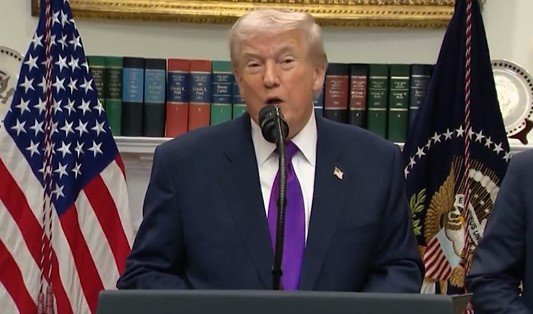


Throughout the briefing, the former president emphasized the vital role farmers play in the nation’s recovery. “Farmers are an indispensable national asset, part of the backbone of America,” he declared, citing that bankruptcy filings among farms rose 55 percent during the Biden years and that his return to office had reversed that trend. He argued that a president who places farmers first can truly reshape the sector.
Trump also referenced new deals with overseas partners, noting that China was buying “a tremendous amount of soybeans” and that President Xi Jinping would “do even more than he promised to do.” He mentioned Japan’s agreement to purchase $8 billion worth of corn, soybeans, ethanol, fertilizer, aviation fuel, biofuel and rice.
Bessent highlighted China’s commitment to buy “at least $12 million metric tons of U.S. soybeans this season, followed by a minimum of 25 million tons annually for the next three years,” adding that Trump was “ushering in a new golden age for agriculture.” Hassett countered that the previous administration’s policies had driven costs up, noting that 150,000 farms had closed and that annual interest expenses had risen by $8 billion.
The president also pledged to ease environmental restrictions on farm equipment, claiming that many regulations increased the cost and complexity of machinery. He described the changes as “taking that crap off that they put on Biden, mostly.”
Farmers in attendance shared their experiences. Iowa’s Cordt Holub called the payments “Christmas early for farmers,” saying the money would let him keep working the land. He asked the president to secure year‑round sales of E‑15 ethanol, which he praised as a valuable product. Louisiana rice miller Meryl Kennedy warned that imports from India, Thailand and China were hurting local growers, noting that Puerto Rico had previously been a major market for U.S. rice. Trump responded that tariffs solved the issue “in two minutes.”
When reporters asked about inflation, Trump said it was “essentially gone” and that he had significantly reduced it. He also expressed a preference for domestically grown produce, even when cheaper imports were available, and emphasized that farmers wanted “a level playing field,” not permanent subsidies.
The U.S. government has leaned heavily on tariffs and emergency payments to shield farmers from market swings and retaliatory trade actions, especially in the soybean, corn, pork and rice markets. China remains the biggest overseas buyer of U.S. agricultural products, making its import choices crucial to farm economics.
Moreover, the agricultural sector is tightly intertwined with U.S. politics, with rural states often serving as a pivotal block in presidential elections and congressional majorities. Farm subsidies, biofuel mandates and tariff strategies frequently dominate policy discussions during election cycles.
lkj/rs
Stay informed on all the latest news, real-time breaking news updates, and follow all the important headlines in world News on Latest NewsX. Follow us on social media Facebook, Twitter(X), Gettr and subscribe our Youtube Channel.