
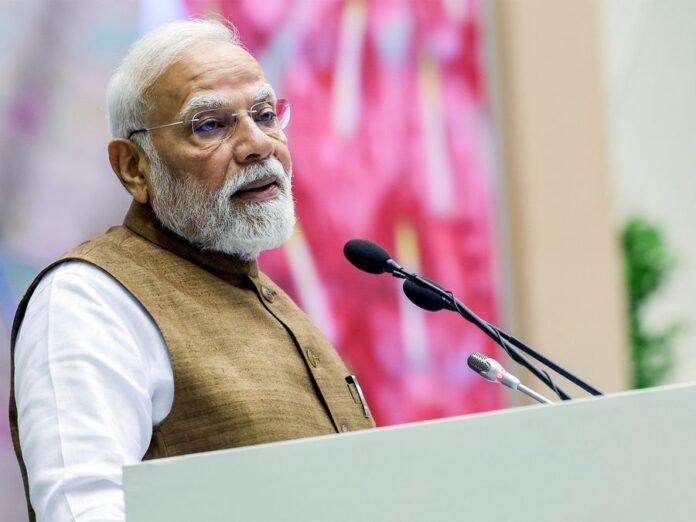
Prime Minister Narendra Modi lit up the International Conference on Gyan Bharatam in New Delhi’s Vigyan Bhawan today, calling the Gyan Bharatam Mission a bold step to showcase India’s rich culture, literature, and ancient wisdom to the world. Speaking to an excited crowd, he painted a vivid picture of how this initiative revives India’s golden past, just days after he announced it and launched its portal.
Modi shared how this isn’t just a government or academic push—it’s a nationwide celebration of our heritage. He praised the timeless wisdom of India’s sages, acharyas, and scholars, whose knowledge in traditions, science, and philosophy shaped civilizations. Through the Gyan Bharatam Mission, India is now digitizing these treasures, and he congratulated everyone involved, from citizens to the Ministry of Culture team.
Imagine flipping through an ancient manuscript—it’s like time travel! Modi urged the audience to picture life centuries ago, when our ancestors wrote with quills on palm leaves or bhojpatra, without modern tools like keyboards or printers. Every letter demanded precision and devotion, treating words as divine. Despite invasions and time’s toll that destroyed millions of texts, India still holds the world’s largest collection—about one crore manuscripts. Families passed them down generations, preserving knowledge with deep reverence.
Modi explained India’s knowledge tradition rests on four key pillars: preservation, innovation, addition, and adaptation. Take preservation—the Vedas, our oldest scriptures, survived orally through Shruti for thousands of years without a single error. Innovation shone in fields like Ayurveda, Vastu Shastra, Jyotish, and metallurgy, with texts like Surya Siddhanta pushing boundaries each era.
Addition meant building on the old: after Valmiki’s Ramayana came gems like Ramcharitmanas, plus commentaries on Vedas and Upanishads exploring ideas like Dvaita and Advaita. Adaptation involved debates in Shastrarth, ditching outdated practices, and reformers in medieval times fighting social evils to protect intellectual heritage.
What makes India unique? It’s not just borders—it’s a living culture from the Himalayas to the Indian Ocean, united in diversity. Our manuscripts, in nearly 80 languages like Sanskrit, Bengali, Kannada, and Malayalam, tell this story. From Gilgit’s insights into Kashmir to Kautilya’s Arthashastra on politics and economics, or Jain and Buddhist texts from Sarnath, they cover devotion, beauty, philosophy, science, medicine, astronomy, and more. Remember zero? India discovered it, as seen in the Bakhshali manuscript, laying groundwork for modern math and computers. Classics like Charaka Samhita and Sushruta Samhita keep Ayurveda alive, while Sulva Sutra shares ancient geometry and Natya Shastra explores human emotions.
Modi shared a cool story from his Kuwait visit: a man showed him documents on India’s ancient sea trade, beaming with pride. He stressed we must track and digitize such scattered treasures worldwide. Today, nations trust India as a guardian of heritage—hundreds of ancient idols are returning, not out of pity, but confidence in our care. In Mongolia, he helped digitize Buddhist manuscripts, returning them enriched for their people.
The Gyan Bharatam Mission thrives on teamwork. Institutions like Kashi Nagari Pracharini Sabha, Asiatic Society in Kolkata, and Saraswati Mahal Library in Thanjavur have digitized over 10 lakh manuscripts. Citizens are donating family heirlooms too—Modi thanked them all. Echoing ancient sages, he said knowledge is the ultimate gift; travelers like Hiuen Tsang took 600 manuscripts to China, and many reached Japan.
India’s leading the charge globally. At G20 cultural talks, we’re partnering with countries like Mongolia (gifting reprinted Kanjur volumes), Thailand, and Vietnam through MoUs. Scholars there are learning digitization for Pali and other scripts. This fights “knowledge piracy”—stopping others from patenting our traditional wisdom by making originals accessible.
Looking ahead, Modi sees huge potential. Digitized manuscripts form a massive data bank for the $2.5 trillion global creative industry, sparking tech innovations and jobs for youth. AI will unlock deeper analysis, translating ancient insights for the world. He called on young people and universities to join, blending Swadeshi spirit with Atmanirbhar Bharat to turn heritage into strength.
Union Ministers Gajendra Singh Shekhawat and Rao Inderjit Singh joined other dignitaries at the event, running till September 13 under the theme “Reclaiming India’s Knowledge Legacy through Manuscript Heritage.” Expect talks on conservation, digitization tech, and global sharing of our incredible manuscript wealth.
Stay informed on all the latest news, real-time breaking news updates, and follow all the important headlines in world News on Latest NewsX. Follow us on social media Facebook, Twitter(X), Gettr and subscribe our Youtube Channel.