

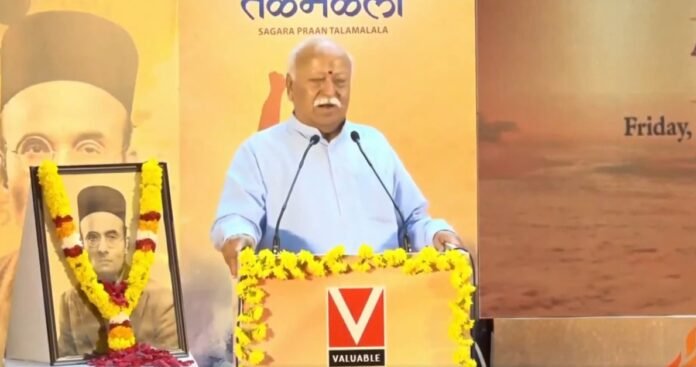
In New Delhi on December 12, RSS leader Mohan Bhagwat and Home Minister Amit Shah jointly unveiled a large statue of Vinayak Damodar Savarkar. During the unveiling, Bhagwat hailed Savarkar as “the brightest guiding star between 1857 and 1947.” The ceremony, hosted in the auditorium of the B.R. Ambedkar Institute of Technology in Pahargaon, was part of a 115‑year celebration of Savarkar’s poem Sagara Pran Talamalala and attracted a strong attendance of officials and the general public.
Bhagwat delivered his remarks on the main stage while senior figures—Home Minister Shah, retired Admiral Devendra Kumar Joshi, the Lieutenant Governor of the Andaman and Nicobar Islands, and Maharashtra Minister Ashish Shelar—were in the audience. He reflected on Savarkar’s broad influence across literature, poetry, law, theatre, and social reform.
Recalling the years Savarkar spent in jail with his brothers, Bhagwat noted that the freedom fighter’s letters were filled with devotion to India. He said Savarkar expressed a willingness for anyone, even a hypothetical family of seven brothers, to sacrifice themselves in prison for the country’s cause. According to Bhagwat, Savarkar treated every skill he learned—whether writing, singing, or legal practice—as a contribution to the nation. “He believed education meant nothing if it did not serve the country,” he added.
Highlighting the need for national solidarity, Bhagwat stressed that India should leave no room for divisive ideologies. He pointed out that Savarkar never aligned himself with any particular caste or region; instead, he identified solely as a servant of the nation.
Bhagwat drew a contrast between past and present generations, saying those of earlier times fought for India’s freedom, whereas today’s citizens must live for its progress. He urged self‑reliance and swadeshi, encouraging parents to inspire their children to work hard and excel—always with the goal of advancing India.
Finally, he painted Savarkar’s vision of the nation as one grounded in cultural pride and unity, noting that the leader saw the country itself as divine. Despite enduring great hardships, Savarkar remained free of bitterness—again, Bhagwat praised him as “the brightest guiding star between 1857 and 1947”.
Stay informed on all the latest news, real-time breaking news updates, and follow all the important headlines in world News on Latest NewsX. Follow us on social media Facebook, Twitter(X), Gettr and subscribe our Youtube Channel.


