
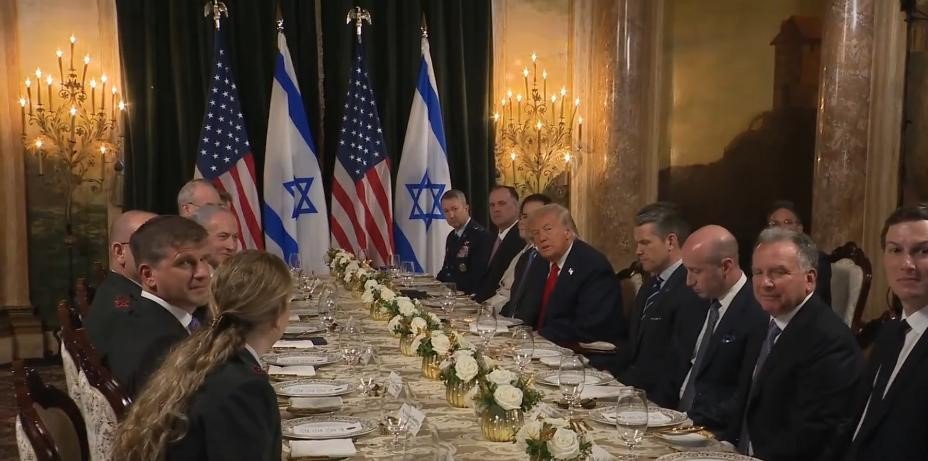
Washington, Dec 30 (IANS) US President Donald Trump warned Hamas to disarm within a “very short period of time,” cautioned Iran against rebuilding military capabilities, and reaffirmed an exceptionally close US–Israel partnership.
“We talked about Hamas and we talked about disarmament and they’re going to be given a very short period of time to disarm,” Trump told reporters during a joint press conference with Israeli Prime Minister Benjamin Netanyahu in Mar-a-Lago on Monday.
He said Hamas had already committed to doing so.
“If they don’t disarm, as they agreed to do… then they’ll be held to pay for them,” Trump said. “They have to disarm within a fairly short period of time.”
Trump said the enforcement would not fall solely on Israel.


“If they say they’re not going to disarm, those same countries will wipe out Hamas,” he said. “They don’t even need Israel.”
He said 59 countries were aligned behind the current peace framework.
“We have 59 countries that signed on, big countries,” Trump said. “This is a real peace in the Middle East and Hamas is a small part of it, but it’s still a part of it.”
Asked whether Israel would withdraw troops before Hamas fully disarms, Trump separated the two issues.
“Well, that’s a separate subject. We’ll talk about that,” he said.
Trump rejected claims that Israel was delaying implementation of later phases of the peace plan.
“They’ve lived up to the plan 100 percent,” he said.
He said his concerns were directed elsewhere.
“I’m not concerned about anything that Israel is doing,” Trump said. “I’m concerned about what other people are doing or maybe aren’t doing.”
Trump repeatedly linked regional stability to Iran, warning that renewed military activity would draw swift action.
“I hope they’re not trying to build up again,” he said. “If they are… we’re going to have no choice but very quickly to eradicate that buildup.”
He said intelligence suggested Iran might be exploring alternative locations after earlier strikes.
“The sites were obliterated, but they’re looking at other sites,” Trump said. “They’re looking.”
Trump said Iran would face consequences if those reports were confirmed.
“Consequences will be very powerful, maybe more powerful than the last time,” he said.
At the same time, Trump said he was open to diplomacy.
“Yeah. I would,” he said when asked whether he supported bilateral discussions with Tehran.
Trump said he had previously urged negotiations.
“I said, let’s negotiate, and they didn’t believe what was going to happen would happen,” he said. “Now they believe me.”
Netanyahu praised Trump’s approach and personal commitment to Israel.
“We’ve never had a friend, even close to a friend as President Trump in the White House,” Netanyahu said.
He described their cooperation as “a partnership second to none.”
Netanyahu announced that Israel would award Trump the Israel Prize, the country’s highest civilian honor.
“We decided to break a convention,” Netanyahu said, noting that the prize had never before been awarded to a non-Israeli.
“We’re going to award it this year to President Donald J. Trump for his tremendous contributions to Israel and the Jewish people,” he said.
Trump called the recognition “a great honor.”
Trump described Netanyahu as a wartime leader whose decisions had shaped Israel’s survival.
“He’s a wartime prime minister at the highest level,” Trump said.
“If you had eight out of 10 prime ministers in his position right now… you wouldn’t have Israel any longer,” he added.
Trump said the broader peace effort had been made possible by earlier US actions against Iran.
“If we didn’t do what we did to Iran… you wouldn’t have peace in the Middle East,” he said.
Trump also addressed Syria, saying the US had an “understanding” with the country’s new leadership.
“I respect him. He’s a very strong guy,” Trump said.
Netanyahu said Israel’s priorities were security and protection of minorities.
“Our interest is to have a peaceful border with Syria,” he said. “We want to secure our Druze friends.”
He added that “Christians should be protected as well in Syria and throughout the Middle East.”
On Lebanon, Trump said Hezbollah remained a concern. “Hezbollah has been behaving badly,” he said.
Trump said the Abraham Accords would expand. “They’ll be expanded fairly quickly,” he said.
Throughout the press conference, Trump stressed deterrence backed by force if required. “If they build up, there can’t be peace in the Middle East,” he said, referring again to Iran.
Hamas has governed the Gaza Strip since 2007 and is designated a terrorist organization by the United States. Repeated ceasefire efforts have failed over disarmament and security guarantees.
Developments in West Asia are closely followed by India and the Indian diaspora due to strategic interests, energy security, and the presence of millions of Indian nationals across the region.
lkj/rs
Stay informed on all the latest news, real-time breaking news updates, and follow all the important headlines in world News on Latest NewsX. Follow us on social media Facebook, Twitter(X), Gettr and subscribe our Youtube Channel.