
A heated debate has erupted in Jammu and Kashmir over the official holiday for Eid-e-Milad-ul-Nabi, the birthday of the Prophet Muhammad. The government declared Friday a public holiday across J&K, aligning with how all Central government offices observed the day. However, many local leaders and religious figures are unhappy with this decision.
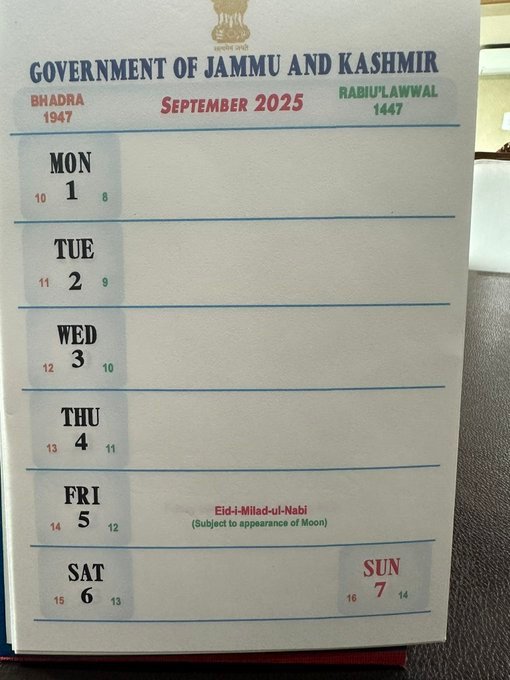
J&K Chief Minister Omar Abdullah raised questions about the holiday, pointing out that the official calendar states that the date depends on the moon sighting. He criticized the government for not shifting the holiday to Saturday, which he says would match the religious observance. Omar Abdullah tweeted, “The calendar clearly says the holiday depends on the moon sighting. Not shifting the holiday is insensitive and hurts people’s sentiments.”
Education Minister Sakina Itoo also voiced her disappointment. She said, “Eid-e-Milad is a sacred day for Muslims worldwide. If the moon sighting shows the celebration should be on Saturday, why was the holiday announced for Friday? The government’s decision is unfair and disrespectful to the religious significance of the day.” She added that such decisions should always be made by the elected government, respecting religious sentiments.
The Grand Mufti of Kashmir, Nasir-ul-Islam, also expressed his concerns. He stated, “It’s unfortunate that despite the moon sighting indicating Eid should be on Saturday, the government did not adjust the holiday accordingly. This mismatch shows a lack of respect for the religious importance of Eid-e-Milad.” He urged the authorities to ensure that future official holidays are aligned with religious traditions.
In Jammu and Kashmir, Eid-e-Milad is celebrated with nightlong prayers, which are an important part of the occasion. Typically, after these prayers, a public holiday is observed. According to the Islamic calendar, the prayers this year will take place on Friday night, but the government’s decision to declare Friday a holiday has caused confusion among many.
This disagreement highlights the ongoing debate about respecting religious traditions and the importance of accurate moon sighting in Muslim festivals. Many hope that in the future, official holidays for important religious events will be carefully aligned with the actual moon sighting, respecting both religious customs and public sentiments.