
The Deadline of Destiny: How London’s Budget Hour sealed India’s fate (From the Archives)

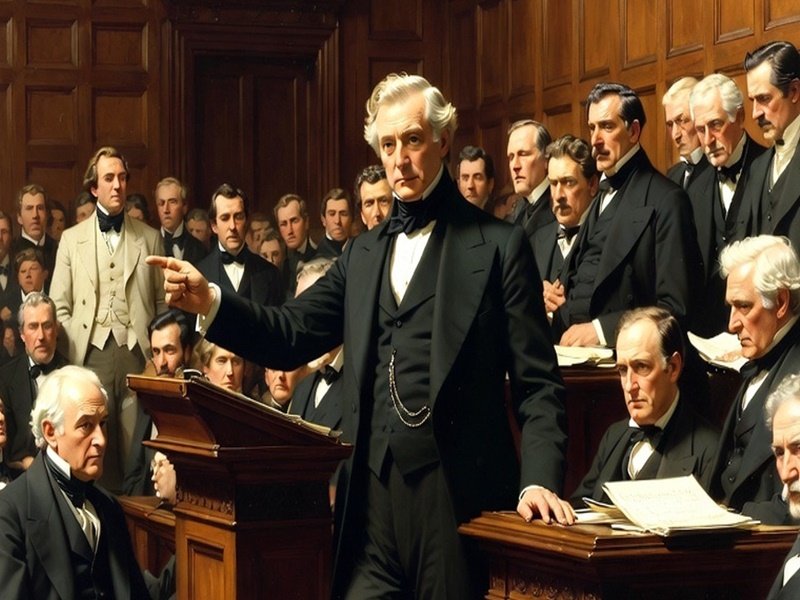
New Delhi, Jan 11 (LatestNewsX) On April 4, 1811, in the House of Commons in London,
the Chancellor of the Exchequer rose to perform a formality mandated by law. It
was a routine step, yet the quiet words he spoke sent a shiver through the East
India Company (EIC) directors and heralded a massive storm of financial,
commercial, and political upheaval that had profound and devastating
consequences for the millions of people in India.
The Chancellor officially gave notice that the EIC’s Charter, which vested in
them the exclusive right of commerce and navigation between the Cape of Good
Hope and the Straits of Magellan, was set to expire in three years, on April 10,
1814.
Simultaneously, he moved for the redemption of a public debt owed by the Crown
to the Company.
For the British Parliament, this moment was the start of a legislative battle
over lucrative trade and political control. For the people of India, whose
resources guaranteed the EIC’s very existence, this formal notice was the final
confirmation that their destiny — their sovereignty, economy, and lives — was
entirely dependent on the decisions of distant, indebted strangers.
This was the deadline of destiny, a moment when the financial sickness of the
EIC was openly discussed, proving that the vast Indian empire was, in reality, a
bankrupt enterprise subsidized by the systematic plunder of its own subjects.




The Redemption and the Revelation of Debt
The EIC, once established by the acts of William III and Queen Anne, had
fundamentally changed its nature, transforming from a simple company of
merchants into a “powerful territorial sovereign” following the grant of Bengal
in 1765.
This transformation legally and financially blurred the lines between its
commercial duties (governed by notions of profit) and its territorial functions
(governed by war and administration).
The announcement of the Charter’s expiration in 1811 came with a mandated
financial prerequisite: the redemption of the debt owed by the British public to
the EIC.
Historically, this public debt represented the initial “valuable consideration”
paid by the Company for its exclusive trade rights, a principle observed until
1767. By redeeming this debt, the British government was symbolically clearing
the slate, preparing to negotiate a fresh contract unburdened by past financial
obligations.
However, the opposition immediately seized upon the notice not as a commercial
transaction, but as a political crisis rooted in EIC’s profound insolvency.
Mr. Creevey, a sharp critic of the Company’s accounting, charged that far from
being solvent, the EIC was in a “distressed state,” incapable of demonstrating
profits from which dividends were legally authorized to be paid. He had earlier
argued that the EIC was “15 millions worse than nothing”.
Another critic, noting the approaching end of the Charter, asserted that the
external or Indian debt of the Company had soared to £30 million.
By 1813, the EIC officially confirmed the true financial scale of its
territorial usurpation: the total interest-bearing Indian debt amounted to
approximately £26 million.
This debt was incurred primarily due to the “defence and protection of the
British possessions in India” and ensuing wars. The financial structure imposed
a colossal and specific annual obligation on the Company in London: nearly £1.5
million was required annually, provided via bills of exchange, merely to cover
the interest payments on this Indian debt.
This demonstrated that the entire apparatus of the EIC—its dividend payments
(like the controversial £630,000), its military expansion, and its political
administration—were not funded by sound trade, but by a mountain of debt,
incurred on Indian soil and ultimately secured by Indian revenues. The act of
redeeming the public debt in 1814 merely emphasized that the British state was
preparing to decide how best to manage the colossal mortgage India had become.
Parliament’s Panic and the Search for Scrutiny
As the 1814 deadline approached, a sense of panic and indignation arose among
several influential peers regarding the lack of preparedness and official
transparency surrounding the renewal process.
In March 1812, Earl Grey, a prominent Whig, expressed profound surprise at the
“lack of official documents” laid on the table by ministers. He questioned
whether the remaining part of the session would afford “adequate time for the
due consideration of so extensive and important a question”.
He noted that ministers seemed to expect the House of Lords to “sit, with their
hands folded” until the measure, which might originate in the Commons, was
brought to them so late that they could not give it due consideration.
The Earl of Lauderdale amplified the crisis. He pointed out that the current
situation bore “not the least resemblance” to the previous charter renewal in
1793. In 1793, the EIC was at least believed to require an “extensive capital”
for trade; now, the Company was known to be operating on virtually nothing.
Lord Lauderdale delivered a statement of breathtaking simplicity and
devastation: the EIC was now carried on by a company who “avowedly had no
capital at all”.
Lauderdale passionately argued that the government should not negotiate the
renewal solely with the EIC directors, but must consult the nation’s “distressed
manufacturing and commercial interests”. His motion on April 9, 1812, demanded
the correspondence regarding the Charter renewal and existing trade regulations,
fearing that agreements made privately between ministers and the Company might
render any public trading privileges “nugatory”.
The opposition’s demands for documents were fueled by the EIC’s history of
obfuscation and the known inadequacy of existing oversight. Mr. Creevey had
repeatedly attacked the Select Committee appointed to inquire into EIC affairs,
arguing it was “utterly incompetent and inadequate to furnish… information”.
He alleged that this “celebrated Committee upstairs,” despite sitting for four
years, had been occupied “not in fact been occupied altogether more than four
hours, or six at the utmost” during the current session, seemingly “avoided all
trouble of discussion of the company’s affairs”.
The consensus among critics was clear: the public was being deliberately kept in
the dark about the true state of affairs while the EIC and the government
negotiated a deal behind closed doors.
The Indian Perspective on the Monopoly
The approaching expiration was viewed by the ruling British class primarily as a
commercial and political dilemma for the Empire. For the Indian populace, it was
a moment of deep economic pain, revealing how their governance was sacrificed to
maintain this unsustainable monopoly.
The EIC, in its 1813 petition for renewal, asserted that its “chief object” had
been the “welfare and happiness of the inhabitants,” leading to an “eminently
conspicuous” amelioration of their condition, including the establishment of
“courts of justice”.
However, the reality presented in the parliamentary papers suggests the
opposite:
Justice Denied to Indian Subjects: The system of governance was financially
sound only when it disregarded the just claims of its native subjects. The
memorial of the creditors of the late Rajah of Tanjore presented in March 1811
stood as a powerful counter-narrative.
The EIC had deposed the Rajah and seized the revenues of the “rich and fertile
districts”.
Despite investigations proving the legitimacy of the native creditors’ claims
(which amounted to only around half a year’s revenue from the seized
territories), the money remained unsettled for over 14 years.
These Indian merchants, including “soucars (sahukars) or native bankers,” were
reduced from “affluence to the greatest distress” and “despaired of obtaining…
justice” from the Company. The EIC was evidently prioritizing the provision of
£1.5 million annually for British creditors over satisfying legitimate,
immediate claims from its subjects in India.
The Engine of Extraction: The massive debt that defined the EIC was directly
passed down to the Indian populace through exploitative land revenue policies.
These policies were designed to give the British “complete control over this
sector,” leading to “agrarian stagnation, the growth of absentee landlordism,
and peasant misery”. Peasants were compelled to pay “high, often arbitrarily
fixed, tax rates” even when crops failed. The entire debt structure, which the
British government was now forced to address, was thus a direct reflection of
the suffering and financial burdens imposed on India.
Suppression of Indian Enterprise: The EIC monopoly did not just suppress British
private trade; it actively stifled the economic potential and industry of India
itself. The highly contentious debate over India-built ships exposed how British
domestic interests were prioritized over Indian economic advantage. London
shipbuilders vehemently opposed the use of Indian-built ships, arguing it would
ruin their industry and threaten naval power.
They succeeded in restricting the trade, which was viewed from the Indian
perspective as an act of “injustice and oppression” that deprived natives of the
benefit of their “great natural advantages” (such as durable teak wood) and
denied the rewards of their industry.
The Unjust Exclusions
As Parliament prepared for the renewal, hundreds of petitions flooded
Westminster from virtually every major port and manufacturing center in the
United Kingdom, demanding the abolition of the monopoly.
The central grievance of the British petitioners, which indirectly exposed the
injustice faced by India, was the “unnatural and extremely hard” reality that
“foreign nations in amity with his Majesty”—specifically the United States of
America—were permitted to trade freely with British possessions in India and
China, while British subjects were excluded.
Petitions from towns like Glasgow, Paisley, and Birmingham stressed that open
trade would provide a “vital substitute for lost European commerce” due to the
Napoleonic Wars and the enemy’s anti-commercial system. They argued that
American merchants had already demonstrated the superiority of private
enterprise, underselling the EIC and carrying away much of the China trade.
The key irony, from the perspective of India, was that the British ruling power
used India’s “vast revenues” to maintain a system that privileged foreign trade
over both domestic British commerce and, critically, Indian enterprise itself.
This demonstrated that the EIC’s primary objective was not commercial prosperity
for the empire, but control: the maintenance of a “sole whole and exclusive
trade” for its own corporate and political benefit, and the denial of access to
anyone (British merchant or native Indian) who might threaten its carefully
managed system.
The Future of Despotism
Despite the torrent of petitions and the serious financial warnings from peers
like Lord Lauderdale, the government, led by Lord Liverpool and Lord Melville,
maintained that the EIC’s monopoly, particularly over the crucial China trade,
was essential for the “security of British India”.
They warned that an “unrestrained resort of Europeans in search of wealth” could
destabilize the subcontinent, whose tranquility was maintained “chiefly by moral
influence, and in a great degree even by prejudice”.
This argument for continued control, even at the cost of recognized injustice
and economic inefficiency, exposed the true nature of British rule that the
Charter renewal aimed to preserve. It was a despotism built on debt and
sustained by fear.
Political Fragility: The EIC’s petition underscored the fear that any change
could “alarm them [the natives], and their submission to British authority would
be greatly endangered” by an “unrestrained resort of Europeans”. This was a
tacit admission that the entire structure relied on maintaining native
ignorance, an idea made explicit during debates on the fettered press in India.
The Cost of Secrecy: The refusal by ministers to submit the necessary documents
promptly, and the general avoidance of “trouble of discussion” by the Select
Committee, confirmed the opposition’s fear that the government intended
Parliament merely to “put the seal to the contract” already agreed upon with the
Company.
The formal notice of the Charter’s expiration was therefore merely the
administrative starting gun for a negotiation whose outcome had already been
determined by the deep-seated financial necessity of the British Empire.
The EIC, having successfully converted India into a territorial state with
massive revenues but even greater debt, used the threat of chaos upon its
dissolution to compel Parliament to continue its commercial privileges.
The Charter expiration in 1814 was not the end of the East India Company’s rule,
but the beginning of its formal transition into a direct instrument of imperial
finance, ensuring that the heavy, suffocating mortgage of £26 million in war
debt—the harvest of conquest—would remain permanently charged to the land and
labor of India.
The question debated in London was not if the money would be paid, but how the
oppressive system that guaranteed its payment could be reformed just enough to
satisfy British merchants while remaining absolutely rigid toward the needs of
the Indian population.
(The author is a researcher specialising in Indian History and contemporary
geopolitical affairs)
–LatestNewsX
scor/
Stay informed on all the latest news, real-time breaking news updates, and follow all the important headlines in world News on Latest NewsX. Follow us on social media Facebook, Twitter(X), Gettr and subscribe our Youtube Channel.