
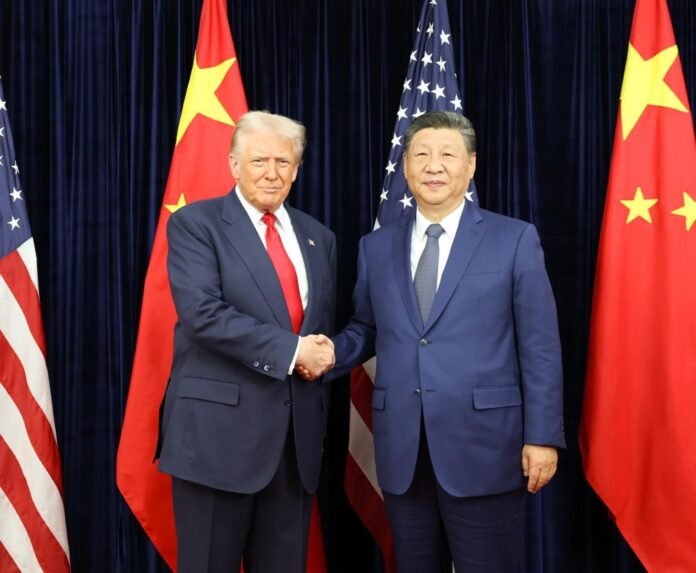
Washington, Dec 4 – President Donald Trump said China is now the focal point of his administration’s economic and national‑security strategy, claiming that the tariffs he imposed, the stricter technology rules, and new incentives for domestic manufacturing have turned the United States into “the hottest country anywhere in the world.” During a briefing in the Oval Office where he rolled back Biden‑era auto‑efficiency rules, Trump kept referencing China, touching on trade, artificial‑intelligence, semiconductor controls and lawsuits that challenge his tariff program. He told lawmakers and industry leaders that the United States has outpaced Beijing in strategic technologies, “AI, we’re leading China in AI. We’re leading everybody in AI. We’re leading everybody in everything.” This assertion was linked to a broader claim that the country is experiencing a surge of industrial investment, with “we have the hottest country anywhere in the world. One year ago, we had a dead country, and now we have the hottest country anywhere in the world.” Tariffs were presented as the main engine of that shift, “It’s bringing in trillions of dollars of wealth. It’s bringing in national security,” Trump said, describing tariffs as a geopolitical tool and noting he has stopped eight wars, five of which were driven by trade issues. China again featured prominently as Trump rebuked a court action aimed at limiting his tariff authority, labeling the challengers as “bad people” who “represent foreign countries, including China, but they represent…people that really don’t like our country…scum.” He also recounted confusion among officials about tariff revenue, joking that when $30 billion appeared “where did it come from? I said, why don’t you check the tariff shelf?” When aides first denied that the tariffs were effective, Trump countered, “No, it started two months ago,” and later confirmed the origin was indeed tariffs. Semiconductor policy came up briefly during a discussion on export controls and NVIDIA’s operations in China. Asked if he had told NVIDIA CEO Jensen Huang about the controls, Trump claimed, “He knows, he knows very well.” He outlined a vision of a rapidly growing domestic chip footprint, stating that within the last year or two the U.S. “had none, and now we’re going to have a very big percentage.” Trump tied that growth to his tariff strategy, insisting that chipmakers must build domestically or face tariffs and loss of access to the U.S. market. In another exchange, the president addressed a “mileage blocker” device that auto dealers said was disrupting vehicle‑lease markets, noting that the National Automobile Dealers Association chair said it was “being distributed through China through distributors selling them online through Great Britain,” to which Trump remarked, “Wow. That’s so good… I’ve never heard of it.” He reiterated that tariffs on China and other partners underpin his industrial policy, claiming they bring in “trillions of dollars,” halt wars, and bolster national security. Trump linked Chinese competition to the earlier offshoring of U.S. auto production and claimed his tariffs now encourage automakers to relaunch plants in the U.S. after they left Mexico and Canada. U.S.–China economic tensions have deepened over tariffs, technology transfers, supply‑chain security, and semiconductor export controls. The Trump administration rolled out sweeping duties on Chinese goods in 2018, sparking retaliatory measures and forcing multinationals to rethink manufacturing strategies. The administration has tightened restrictions on advanced chips and AI‑related hardware destined for China, citing security risks and competition concerns, while promoting domestic chip production through bipartisan‑endorsed incentives and reshoring policies.
Stay informed on all the latest news, real-time breaking news updates, and follow all the important headlines in world News on Latest NewsX. Follow us on social media Facebook, Twitter(X), Gettr and subscribe our Youtube Channel.