

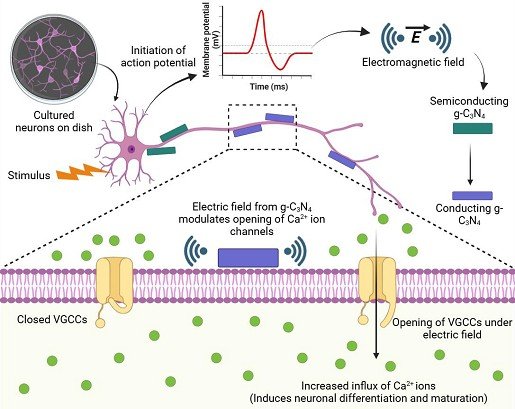
Scientists at India’s Institute of Nano Science and Technology (INST), part of the Department of Science and Technology, have created a groundbreaking nanomaterial that chats directly with brain cells in a natural way. This innovation, called graphitic carbon nitride or g-C₃N₄, could change how we treat brain disorders like Parkinson’s and Alzheimer’s.
The team shared their findings in the journal ACS Applied Materials and Interfaces. Unlike traditional methods that rely on electrodes, lasers, or magnets to stimulate neurons, this nanomaterial taps into the brain’s own electrical signals to boost cell growth and communication. It helps neurons mature, form stronger connections, and even ramps up dopamine production in lab-grown brain tissue—key for fighting Parkinson’s symptoms.
Dr. Manish Singh, who led the research at INST, called it a game-changer. “This is the first time we’ve seen semiconducting nanomaterials like g-C₃N₄ directly influence neurons without any outside help,” he said. “It could open doors to new treatments for neurodegenerative diseases.”
In animal tests, the material also cut down on harmful proteins tied to Parkinson’s, showing promise as a non-invasive option. Current therapies, like deep brain stimulation, often involve surgery and implants, which carry risks and limitations. But g-C₃N₄ acts like a smart partner for the brain: when near nerve cells, it creates tiny electric fields from the brain’s natural voltage changes. These fields trigger calcium channels, sparking healthy activity and neuron links without gadgets.
What makes it special? The nanomaterial is biocompatible, meaning it works safely with living tissue, and it switches responses based on whether neurons are resting or firing. This could lead to therapies that millions with brain conditions desperately need.


Looking ahead, the discovery might even shape futuristic tech like brainware computing. Researchers are already growing mini-brains, or organoids, in labs as biological processors. Pairing them with g-C₃N₄ could supercharge bio-inspired computing, blending biology and tech in exciting ways.
That said, the team stresses more animal and human trials are essential before real-world use. “This shifts how we think about neuromodulation,” Dr. Singh added. “From healing brain injuries to tackling neurodegeneration, these nanomaterials could transform lives.”
Stay informed on all the latest news, real-time breaking news updates, and follow all the important headlines in world News on Latest NewsX. Follow us on social media Facebook, Twitter(X), Gettr and subscribe our Youtube Channel.