
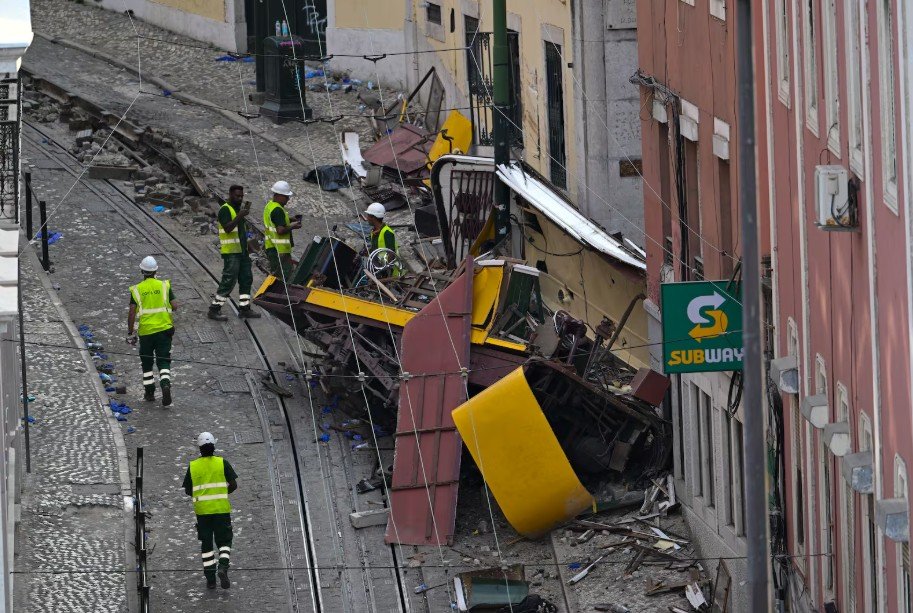
A snapped steel cable has been confirmed as the cause of the deadly Gloria Funicular accident in Lisbon, Portugal, which claimed 16 lives and left 22 others injured.
According to Portugal’s transport accident authority, GPIAAF, the cable broke at a hidden point inside one of the cars. Officials stated that this critical flaw would have been impossible to spot during the routine visual checks carried out earlier that day.
The investigation reveals that once the vital balancing cable failed, the funicular’s pneumatic and manual brakes were simply not enough to stop the cars. While an emergency system did cut power and trigger the brakes, investigators believe it may not have activated correctly on every single car.
Tragically, the cable that broke had been installed less than a year ago and was still well within its expected service life. Maintenance for the historic railway was handled by an external contractor.
In a concerning detail, the Gloria Funicular is not under the direct, ongoing supervision of the national transport regulator. Instead, it only undergoes independent, in-depth inspections once every four years.



Reconstruction of the event shows one of the cabins recoiled at a terrifying speed of approximately 60 km per hour before it derailed.
The victims included three British nationals. Two have been identified as Kayleigh Smith, a theatre director, and her partner Will Nelson, a lecturer. The third British victim has not yet been named. The tragedy also took the lives of five Portuguese nationals, as well as two Canadians, two South Koreans, and one citizen each from the U.S., France, Switzerland, and Ukraine.
Portugal’s Prime Minister, Luis Montenegro, called the derailment “one of the biggest tragedies of our recent past.”
In the wake of the accident, the U.S. State Department confirmed its embassy in Lisbon is working with local authorities to assist American citizens affected by the incident.
A full preliminary report on the funicular accident is expected within 45 days, though final conclusions could take up to a year.
The Gloria Funicular is a 140-year-old Lisbon institution, a vital piece of transport for navigating the city’s steep hills and a major attraction for tourists visiting the Portuguese capital.