


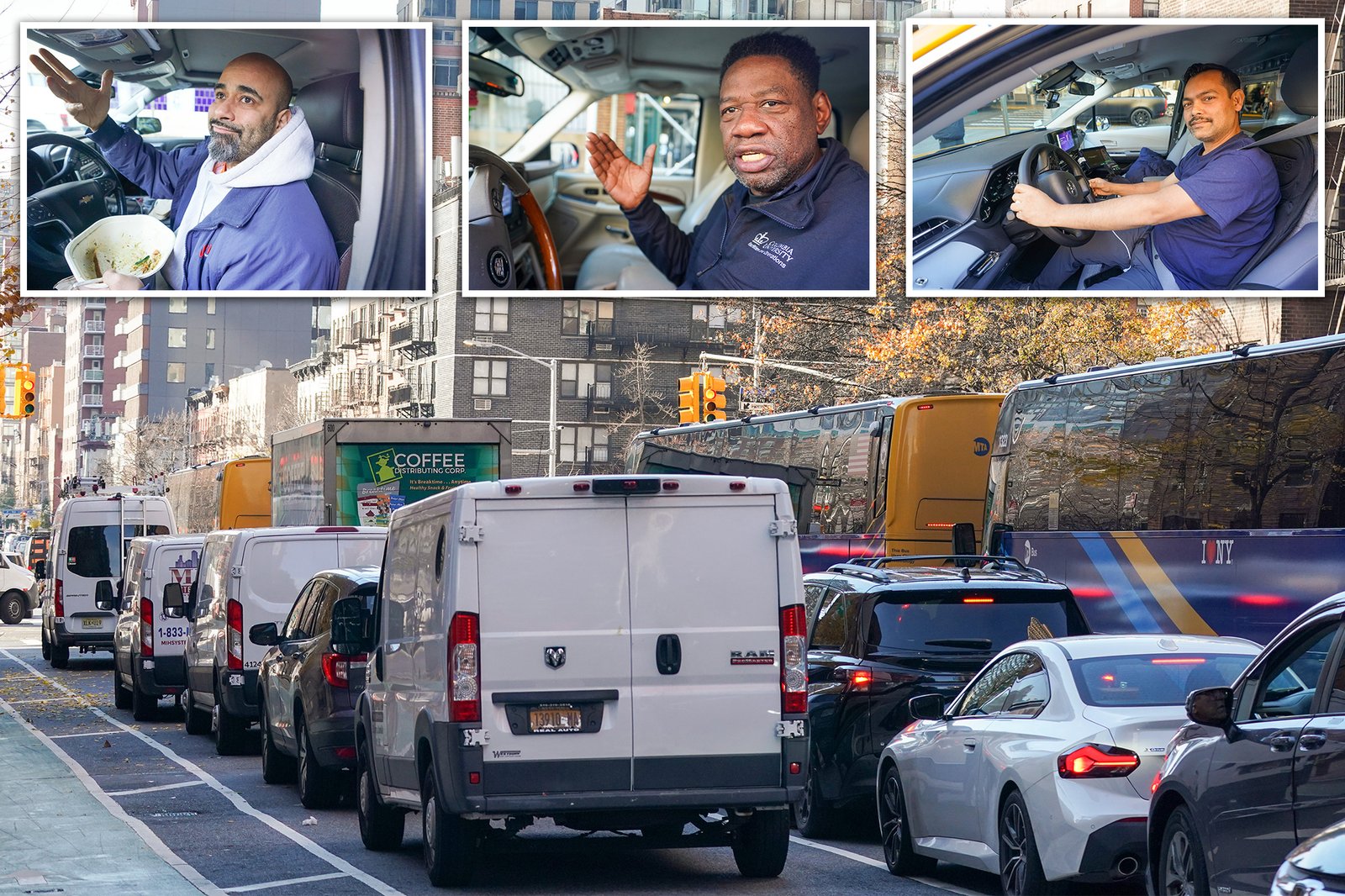
While Gov. Hochul and MTA officials celebrate congestion pricing as a hit that’s cutting traffic in central Manhattan, other experts caution that the benefits might not be as clear-cut.
At the same time, drivers are outraged: traffic is still a nightmare, and many are paying higher tolls after nearly a full year.
The MTA, eager to justify the new charges, suggested that a “polling” campaign indicated drivers were warming up to the congestion fee, even though many say downtown remains a gridlock nightmare.
“This program has been nothing short of transformational, making streets safer, reducing gridlock across the region, and unlocking generational upgrades to mass transit, benefitting millions,” Hochul announced in September.
“Congestion pricing is working, it is legal, and the cameras are staying on.”
Yet yellow cabbie Mohammad Haque remarked, “It hasn’t changed anything, especially south of 60th.”
He added, “From what we’ve seen, the traffic is even worse. In my opinion, they’re just taking the money and not helping the city at all. Traffic is still there and we’re losing time – and the MTA, they’re just taking the money.”
The MTA had projected that a $9 toll would bring in $500 million in its first year, a figure that has already been surpassed.
It also claims an 11% drop in vehicles within the congestion zone. However, data from the Port Authority indicates that crossings in and out of New Jersey onto the zone actually fell by under 5% year over year according to the most recent April reports.
Critics have also questioned the MTA’s upbeat statistics.
Nicole Gelinas, a senior fellow at the Manhattan Institute, called the MTA’s data collection a “crude way of doing it, and it hurts confidence in the program.”
“The cameras were set up ages before congestion pricing started,” she explained. “The MTA should have collected real data for comparison during the long delay.”
To gauge the toll’s impact, the MTA compared traffic data in the congestion zone before and after implementation. Critics argue that the baseline numbers were merely estimates—projecting how many cars would have entered if the charge had never existed.
Alison Conway, a civil‑engineering professor at CUNY, noted that the MTA used a single day in October to generate those numbers, leaving “room for a lot of uncertainty in how representative that day is.”
Although Conway argued the day was chosen carefully, she stayed cautious: “If there were unusual weather or construction, the adjustment could swing too high or too low, skewing the real baseline.”
Port Authority data also offers insight into traffic changes.
Traffic across the Lincoln and Holland tunnels saw a year‑over‑year drop of about 6.7% in January and roughly 10% in February, with smaller decreases of 5.4% in March and 4.9% in April.
Overall movements between New York and New Jersey were down just 0.4% year over year, while traffic on the George Washington Bridge actually rose as drivers try to avoid the charge.
By contrast, the MTA reports an 8% drop in vehicles entering the congestion zone in January, 12% in February, 13% in March, and 12% in April—suggesting its counts predict steeper declines than what the Port Authority records. These figures also don’t account for other possible entry routes into Manhattan.
The MTA said it had seasonally adjusted the October data using bridge and tunnel traffic from city and state sources.
During an NYU Law School event, MTA CEO Janno Lieber touted that the program has made drivers happier, citing an unspecified poll and claiming a reduction of about 20 million vehicles this year, alongside improvements in pedestrian flow and air quality.
“You know, who loves congestion pricing? The drivers are now, in polling recently, are letting us know they love it because they’re saving so much time,” he said.
“The people who drive to work in Manhattan who spend 50 bucks to park actually do value their time. I’m not shocked.”
When pressed for details about the poll, the MTA first referred to a September survey of 800 people – not limited to drivers – where 59% said they supported the program.
The agency later sent a second poll, specifically asking drivers, which said that roughly three‑quarters reported faster commutes into the central business district. Yet the data comes from early February, when the congestion zone had just been in effect for a month.
A taxi driver like Haque isn’t sharing the optimistic tone set by Lieber.
“I don’t notice any difference. Look at the traffic here – from morning until 8 p.m. every day, every single day. They took lanes away for buses, lanes for bikes – what’s congestion pricing doing?” he asked. “Someone should ask them what they’re doing with all this money. New York should do something about traffic, but not this. This is not good for us. This is not good for the city.”
Electrician Deacon Howard from Staten Island said the $9 charge and even higher fees for trucks are not easing traffic; people still have to drive.
He estimated he’s been shelling out roughly $2,000 more than he was last year.
“It’s the same traffic, just more fees. I don’t see no difference. Four years ago it took me an hour and a few minutes to get to work,” Howard, 62, said. “Now it takes me an hour and five minutes to work. So where’s the difference?”
Construction foreman Rad Perez from Chinatown also argues that the daily fee “hasn’t alleviated anything.”
“As contractors, we have to charge our clients to drive below 60th, so someone’s paying it and we’re still driving,” Perez said. “So congestion pricing is doing nothing. All that money is going nowhere I can see. Being in New York for 50 years, I knew it was never going to work, and now they’re just charging more taxes, more fees, taxes on top of fees and fees on top of taxes, and it’s just never ending.”
Some drivers noted that traffic was less bad when the toll began, but it worsened over time.
“In the beginning with the congestion it was good because there were less cars in the city. So the traffic was not that bad. But right now, it’s really bad,” said taxi driver Eric Oppong, 33.
“People don’t care. They still come to the city and there’s traffic everywhere. Sometimes it takes an hour to go 1.5 miles. Us taxi drivers hate the commute, I mean, I thought the congestion thing was gonna help, but it really didn’t.”
Stay informed on all the latest news, real-time breaking news updates, and follow all the important headlines in world News on Latest NewsX. Follow us on social media Facebook, Twitter(X), Gettr and subscribe our Youtube Channel.


