

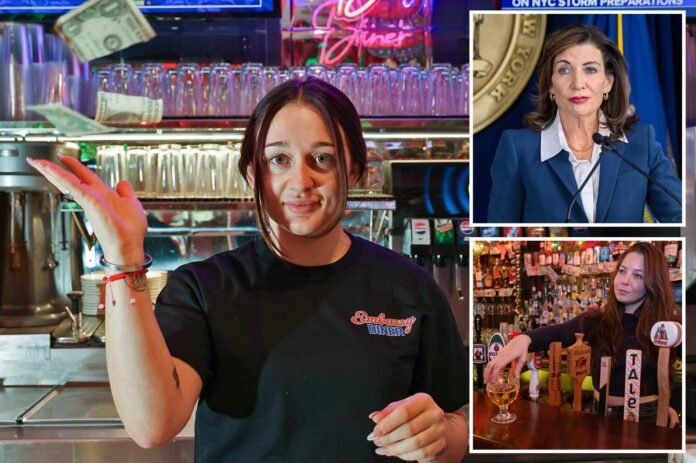
When a bartender at a Midtown Irish pub told a reporter, “Screw her,” the frustration in his voice made clear that the issue goes beyond a single bar. A handful of New York City and state workers say that Gov. Kathy Hochul’s decision to keep the state income tax on tips and overtime income flat has robbed them of a federal tax break that could mean thousands more dollars at the end of the year.
The federal “no tax on tips” policy, part of President Trump’s 2022 “One Big Beautiful Bill,” allows qualified service workers to deduct up to $12,500 of tip income a year—and $25,000 for married couples—on their federal taxes. Starting in 2025, this incentive is to remain in place through 2028. A similar deduction applies to overtime pay. In a move that expanded the benefit to roughly 70 categories of workers—including taxi drivers, golf caddies and food‑service staff—U.S. Treasury officials applied the break to service jobs that depend heavily on tips.
“If we weren’t taxed on our tips, we’d be able to save more, we’d enjoy life a little more, maybe we wouldn’t have to pick up that extra shift,” the bartender, Rion Gallagher, 30, said. “Screw her,” he added about Hochul.
Zoe Kalodimos, a 30‑year‑old waitress at Embassy Diner in Bethpage, echoed that sentiment. “It’s disgraceful. People live off of tips,” she said. “For [Hochul] to do that is just, it’s disheartening. It’s upsetting.” Kalodimos estimates that the state’s tax on tips drains about $1,000 from her pocket each month. “It’s like losing money. So it’s hard, especially when everything’s so expensive in life right now. That’s my livelihood, that’s how I eat and feed my family,” she added.
Other workers in the state have echoed these worries. Jackie Puttre—who has worked as a server for 37 years and now manages P. McDaid’s Irish Pub in Midtown—chided legislators for “doing some good” before handing a tax break back to the state. “Thanks for nothing,” she told Hochul.
David Aju, a server at Anatoly 56 Greek Taverna in Midtown, explained how the rise in credit‑card tips has made the tax more burdensome. “I get most tips from credit cards, so that means everything is getting taxed,” he said. “Honestly, if my check comes out good, but then they take out a lot of taxes, it’s bad for us.”
Hannah Teal, 33, who tends bar at George and Jack’s Tap Room in Williamsburg, revealed that her take‑home pay after taxes was $40,000 last year. “It sucks to be taxed! That’s why we love cash tips!” she joked, noting she could have taken home an extra $3,000 if state taxes were not applied. “How do you survive on $40,000 in New York City? You don’t!”
While the federal government rolled out the break, the state of New York has declined to match it, a decision that has left many service workers across the state feeling short‑changed. According to a Reuters piece (first reported), the state could be losing more than $1 billion in revenue from not adopting the deductions, a figure that a Hochul spokesperson disputed. The governor’s office said the issue was still under review.
“There are conversations happening and will be decided upon in the new year,” a spokesperson for the city’s Department of Finance told reporters. “Conversations are ongoing and will be decided upon in the new year.”
The frustration among workers echoes broader political battles over labor policy. Trump’s Treasury Secretary, Scott Bessent, blasted the decision as “political obstructionism,” accusing liberal states of preventing workers from reaping federal benefits. “This partisan stonewalling is a direct assault on the very families and workers liberal politicians claim to champion,” he said in a statement.
Bruce Blakeman, the Nassau County executive and a Republican running for governor, also called out Hochul. “Kathy Hochul is sticking it to the service industry by blocking real tax relief on tips and overtime—costing servers up to $3,000 a year,” he told the Post. A Hochul spokesperson replied that the governor still had “ways to put money back in New Yorkers’ pockets and will evaluate federal changes in the context of the upcoming budget.”
Restaurant owners have weighed in too. John Winterman, owner of Francie restaurant in Williamsburg, said that if restaurants had tax breaks, they could pay employees better. “If [Hochul’s] not working to help restaurants get the tax breaks they need, it’s an uphill battle for us,” he said. Sammy Musovic, owner of Sojourn Social on the Upper East Side, warned that a lack of tip tax relief could push wait staff out of the city. “Eighty percent of [servers’] income comes from tips—that would have been a big boost for them. It would have helped us to retain employees,” he said.
Tatiana Cruz, 25, bartender at Teddy’s in Williamsburg, agrees that tips should not be the only safety net. “I think every restaurant should pay servers livable wages, so we don’t have to depend on tips,” she told reporters.
The debate over tip tax policy reflects a larger conversation about affordability and workers’ rights in New York. As the state’s lawmakers weigh the potential revenue impact against the needs of gig‑style and low‑wage workers, the next legislative session will likely bring a clearer answer. For now, the workers across the state await a decision that could change their wages, savings, and ability to navigate the city’s high cost of living.
Stay informed on all the latest news, real-time breaking news updates, and follow all the important headlines in world News on Latest NewsX. Follow us on social media Facebook, Twitter(X), Gettr and subscribe our Youtube Channel.


