

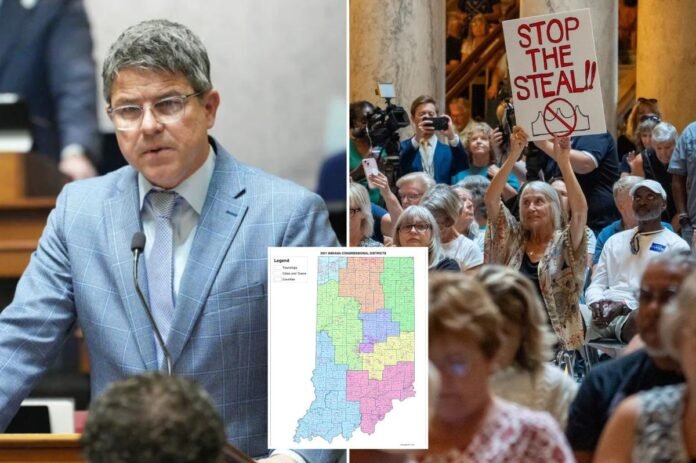
The Indiana Senate just broke off its planned December meeting that was meant to approve new congressional maps. Republican Senate President Pro‑Tem Rodric Bray said there simply aren’t enough votes to move forward, even after weeks of pressure from the White House and visits by Vice‑President JD Vance.
Indiana is the second GOP‑led state to reject President Trump’s push to redraw districts that would give his party a better shot in the 2026 midterm elections. The state’s Senate and House both hold supermajorities for Republicans, but a growing portion of the chamber now insists that gerrymandering could backfire politically—or be seen as unethical.
“Over the last several months, Senate Republicans have given serious thought to redrawing our state’s congressional maps,” Bray told reporters. “Today, I’m announcing there are not enough votes to move that idea forward, and the Senate will not reconvene in December.”
The decision comes after Vance flew to Indianapolis twice and a meeting in the Oval Office that included state lawmakers. Despite that attention, many Indiana Republicans—especially those representing districts that vote heavily Democratic—have balked at the proposal. State Sen. Kyle Walker said the majority of his constituents oppose new maps, and other GOP leaders like Sen. Liz Brown have suggested keeping the issue off the floor for now.
If the Senate does not act, Indiana may miss the chance to change its congressional map before the 2026 filings close in early February. The House has enough votes to push for new districts, but it’s unclear whether it will meet in December as previously scheduled. Gov. Mike Braun, a Trump ally, called for a special session, arguing that lawmakers should make a fair decision for Hoosiers.
The issue has taken on national relevance. Trump wants GOP‑controlled states—such as Texas, Missouri, Ohio, and North Carolina—to adopt redistricting plans that favor Republican candidates. Democrats, meanwhile, need to capture at least three extra seats to regain control of the House, which Republicans historically lose in midterms.
In California, voters approved maps to help Democrats; in Virginia, the state’s assembly has drafted a constitutional amendment to update districts. Even in Democratic‑led states, redistricting moves have stalled: Illinois lawmakers avoided new maps in October, fearing they could hurt Black voters, and Maryland’s Senate declined to move forward last month.
As the political landscape shifts, Indiana’s decision highlights the broader national debate over how congressional districts are drawn and who gets to decide. The next step for Republicans in Indiana remains uncertain, and the final shape of the state’s congressional map may wait until the special session, if one is convened at all.
Stay informed on all the latest news, real-time breaking news updates, and follow all the important headlines in world News on Latest NewsX. Follow us on social media Facebook, Twitter(X), Gettr and subscribe our Youtube Channel.