

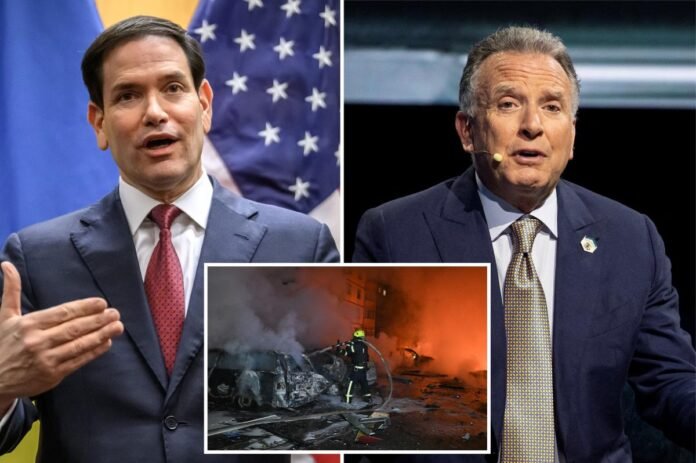
WASHINGTON — Secretary of State Marco Rubio and special envoy Steve Witkoff rushed together on Sunday to keep the White House’s 28‑point Ukraine peace plan moving forward after a wave of bipartisan criticism that the document was essentially a Russian “wishlist.”
Before a pivotal meeting in Geneva, Ukrainian President Volodymyr Zelensky and his European partners voiced strong concerns, arguing that the proposal would force Kyiv into massive territorial compromises.
Despite a tense atmosphere, Rubio, Witkoff, Army Secretary Dan Driscoll, Jared Kushner and other U.S. officials met with Ukraine’s delegation in Geneva. By the end of the session, the Americans agreed to modify the plan.
“I’m not going to speculate,” Rubio said to reporters. “I feel very optimistic that we can get something done here.”
“Obviously, the Russians get a vote.”
A looming source of confusion was the origin of the plan and reports that the Trump administration was threatening to cut aid if Ukraine didn’t accept it.
On Saturday, Rubio tried to calm worries by speaking with a bipartisan group of senators who had attended the Halifax International Security Forum in Canada. Senator Mike Rounds (R‑SD) recalled that Rubio told the group, “It is not our recommendation, it is not our peace plan.”
Senator Angus King (I‑Maine) also said Rubio described the draft as a “wishlist of the Russians.”
Both Rubio and the State Department quickly pushed back, with the secretary stating that the plan was “authored by the U.S.”
“It incorporates input from the Russian side, but it also draws on ongoing input from Ukraine,” Rubio added.
Lawmakers reported that Rubio said he was unaware of any threats to cut aid, contradicting some earlier claims. The secretary denied knowledge of such conversations.
President Trump has publicly announced a desire for the deal to be approved by Thanksgiving.
During Sunday talks, Ukraine presented a counter‑proposal to tweak the 28‑point plan, and the American side was ready to accommodate several of those changes, according to Axios.
Behind closed doors, however, U.S. officials accused their Ukrainian counterparts of leaking key details of the plan to the press, a move they said could spark domestic backlash. Axios reported that senior U.S. officials believe Russia may have leaked the draft.
Zelensky, who initially described the plan as a “choice between losing our dignity and freedom and losing U.S. support,” expressed gratitude for U.S. efforts to end the war that has ravaged his country for nearly four years.
“Ukraine is grateful to the United States, to every American heart, and personally to President Trump,” he posted on X, shortly after Trump criticized Ukraine for showing “zero gratitude.”
“You thank everyone who is helping! Thank you, America! Thank you, Europe! I am proud of our people. Glory to Ukraine!”
Zelensky has insisted that a proper peace plan must address Ukraine’s needs and not reward Russia for its invasion.
The leaked draft calls for Ukraine to make sweeping concessions, including ceding the entire Donbas region—territory Russia has some 15 years of conflict over—and relinquishing its NATO ambitions. Critics warn that surrendering the rest of Donbas would leave Ukraine vulnerable to future Russian attacks, as the ceded cities are heavily fortified and would serve as a springboard for new invasions.
Just last month, Trump favored freezing frontline lines to avoid complicated territorial negotiations, but Russia made it clear that such an approach would be unacceptable.
Under the proposal, Ukraine would also agree never to join NATO, cut its armed forces from roughly 900,000 to 600,000 soldiers, and grant amnesty to all combatants—effectively shielding Russian personnel from war‑crime prosecutions.
Russia was asked to make only a small number of concessions, such as pledging not to invade its neighbors again and securing some guarantees for Ukraine. Those assurances fall far short of NATO’s Article 5, which treats an attack on a member as an attack on the whole alliance, leaving Moscow with little deterrence if it chooses to launch another invasion.
The potential deal sparked immediate backlash from both Democrats and pro‑Ukrainian Republicans. Representative Brian Fitzpatrick (R‑Pa.), who chairs the Congressional Ukraine Caucus, warned on X, “Vladimir Putin has never once kept a single promise that he has made regarding Ukraine. Not once. Ever. And he’s not about to start now.”
“Any agreement that requires any element of trust placed in Vladimir Putin’s ‘promise’ is not worth the paper it is written on,” he added.
European leaders also slammed the proposal. A recently released draft from the EU’s own peace plan—unveiled on Sunday—directly countered the U.S. proposal, guaranteeing Ukraine’s continued NATO eligibility, the ability to maintain its statehood and a frozen front line.
Stay informed on all the latest news, real-time breaking news updates, and follow all the important headlines in world News on Latest NewsX. Follow us on social media Facebook, Twitter(X), Gettr and subscribe our Youtube Channel.