

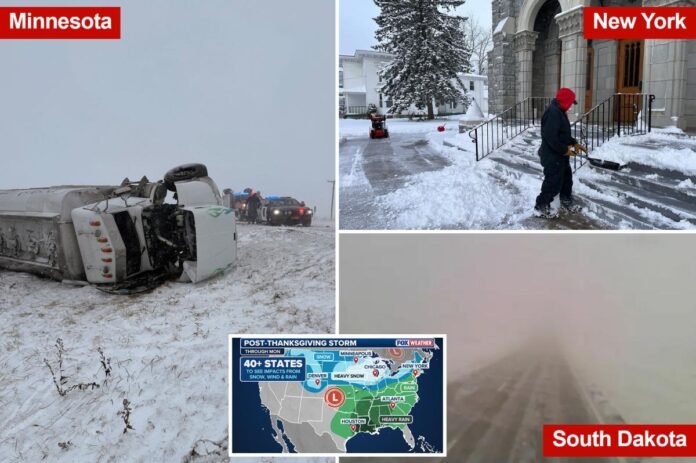
In Marquette, Michigan, the strongest lake‑effect snowstorm of the winter season has broken multiple records, racking up dozens of inches of snow across the Great Lakes Snowbelt. The storm has kept holiday travelers – both motorists and flyers – out of reach as they try to return home from Thanksgiving, and now the lake‑enhanced storm is finally beginning to abate.
By Friday evening, a change in wind patterns will push the heaviest snow down toward the eastern Upper Peninsula, especially near Sault Ste. Marie, a region that had previously evaded the most intense bands.
On the West Coast of the lower East Coast, the cloud deck is expected to concentrate intense snowfall along Interstate 86 near Jamestown and Olean, New York. Further north, another powerful strand of rain‑clouds is projected to hit Interstate 90 and deliver significant totals to Rochester, Syracuse, and possibly Albany in upstate New York.
Road crews and travelers warn that conditions could deteriorate overnight into a full “whiteout road conditions” threat. For instance, parts of Interstate 90 south of Erie, Pennsylvania, were closed yesterday after a vehicle stalled, and speed limits were imposed on Thanksgiving morning.
This comes on the heels of an earlier winter storm that had made travel treacherous, generating hundreds of crashes and dozens of injuries across the Dakotas, Minnesota, Wisconsin, and Michigan. In Milwaukee‑area Ozaukee County, a semi tractor‑trailer lost control on Interstate 43, jackknifed across the median, and struck two oncoming cars, killing one person Wednesday afternoon. Meanwhile, over 55,000 customers lost power early on Thanksgiving Day across Wisconsin, Michigan, and western New York.
The most intense lake‑effect showers will impact Ohio, Pennsylvania, western New York, and the Tug‑Hill Plateau, areas where Lake‑effect Snow Warnings remain active. According to the local FOX Forecast Center, the ice‑cold bands could still funnel nearly a foot of snow into northern New York and northeastern Pennsylvania.
Snow totals surpassed 25 inches in Northern Wisconsin and Michigan’s Upper Peninsula by Friday morning; Hurley, Michigan, recorded 31.3 inches. Gaylord, Michigan, set a Thanksgiving day record with 13.1 inches, toppling the 2023 record of 10.1 inches.
National Weather Service officials urge anyone needing to travel to be ready for rapidly worsening road conditions. “When the snow bands come in, you literally can’t see anything, so this is going to be a no‑travel zone,” warned FOX Weather meteorologist Britta Merwin.
Highways at greatest risk of blizzard‑grade winds and life‑threatening conditions remain the Interstate 90 corridor through Ohio, Pennsylvania, and New York, as well as Interstates 94, 75 and 69 across Michigan.
Meanwhile, the FOX Forecast Center is monitoring a secondary winter blast that will reach over 40 states, just as many holiday travelers head home. Extra wind gusts and heavy snowfall are expected in the Central United States, potentially causing major delays at airports in the Midwest.
The next wave will move through the Central Plains Friday night into Saturday, delivering 5–8 inches of snow to parts of Iowa, southern Wisconsin, and Illinois. Chicago anticipates 8–12 inches starting Friday, which could equal its snowiest two‑day November total since records began in 1884. Airports in Chicago, Milwaukee, and Detroit all face potential delays from wind and heavy snow.
South of Interstate 70, the Mid‑Mississippi Valley and adjoining areas will see successive rounds of heavy rain starting Saturday, with precipitation tracking to the East Coast by Sunday. Travelers should plan for road disruptions that could continue into Monday.
Stay informed on all the latest news, real-time breaking news updates, and follow all the important headlines in world News on Latest NewsX. Follow us on social media Facebook, Twitter(X), Gettr and subscribe our Youtube Channel.